
First days back · Grades K–12 · 8–10 minutes
Back to school after a break
Help students ask for support, check what comes first, and choose one manageable step.
Four grade-band versions. Each includes a student page, a short “Why this helps,” an opening script, and a ready-to-use example. Use after Thanksgiving, winter, spring, or another school break.
Already have an account? Sign in. Plus isn’t required for this bundle.
Grades K–2
Ask for help on the first day back
Point, say, or draw with an adult. Includes a student page and counselor guide for returning after a shared school break.
Read the text version
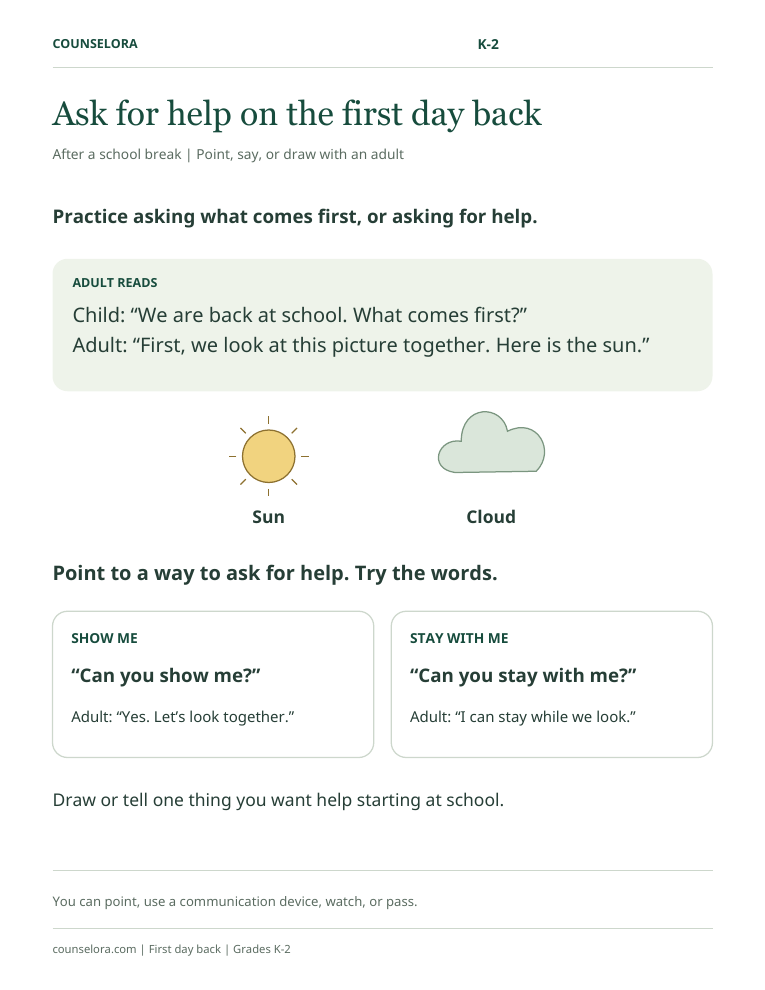
COUNSELORA K-2 Ask for help on the first day back After a school break | Point, say, or draw with an adult Practice asking what comes first, or asking for help. ADULT READS Child: “We are back at school. What comes first?” Adult: “First, we look at this picture together. Here is the sun.” Sun Cloud Point to a way to ask for help. Try the words. SHOW ME “Can you show me?” Adult: “Yes. Let’s look together.” STAY WITH ME “Can you stay with me?” Adult: “I can stay while we look.” Draw or tell one thing you want help starting at school. You can point, use a communication device, watch, or pass. counselora.com | First day back | Grades K-2
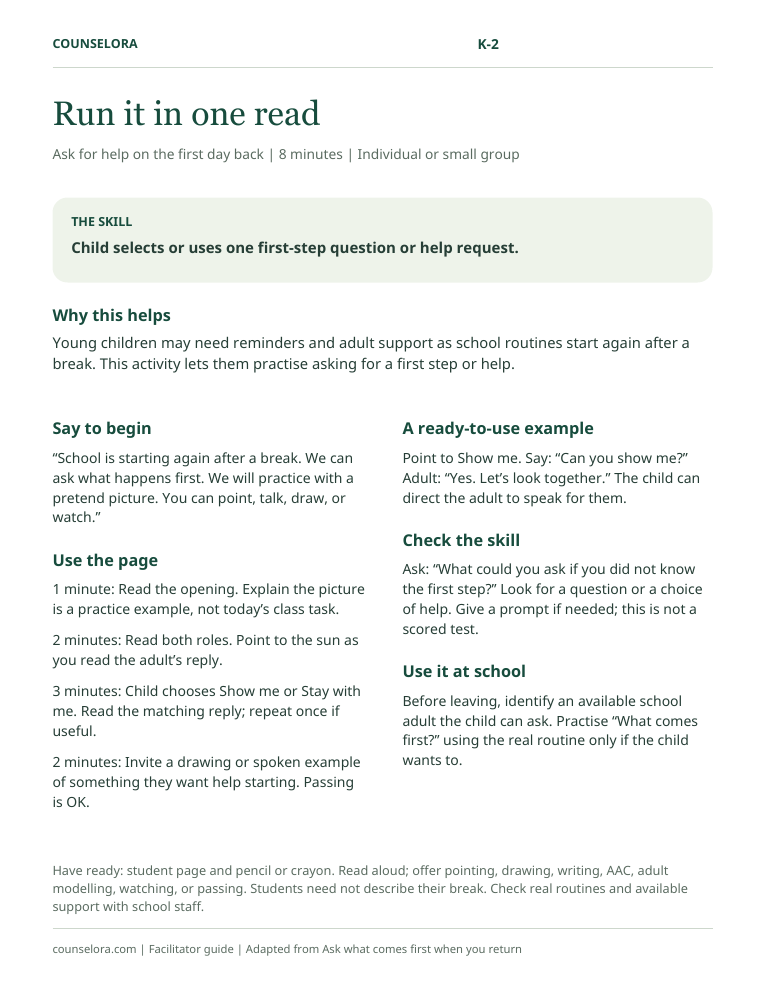
COUNSELORA K-2 Run it in one read Ask for help on the first day back | 8 minutes | Individual or small group THE SKILL Child selects or uses one first-step question or help request. Why this helps Young children may need reminders and adult support as school routines start again after a break. This activity lets them practise asking for a first step or help. Say to begin “School is starting again after a break. We can ask what happens first. We will practice with a pretend picture. You can point, talk, draw, or watch.” Use the page 1 minute: Read the opening. Explain the picture is a practice example, not today’s class task. 2 minutes: Read both roles. Point to the sun as you read the adult’s reply. 3 minutes: Child chooses Show me or Stay with me. Read the matching reply; repeat once if useful. 2 minutes: Invite a drawing or spoken example of something they want help starting. Passing is OK. A ready-to-use example Point to Show me. Say: “Can you show me?” Adult: “Yes. Let’s look together.” The child can direct the adult to speak for them. Check the skill Ask: “What could you ask if you did not know the first step?” Look for a question or a choice of help. Give a prompt if needed; this is not a scored test. Use it at school Before leaving, identify an available school adult the child can ask. Practise “What comes first?” using the real routine only if the child wants to. Have ready: student page and pencil or crayon. Read aloud; offer pointing, drawing, writing, AAC, adult modelling, watching, or passing. Students need not describe their break. Check real routines and available support with school staff. counselora.com | Facilitator guide | Adapted from Ask what comes first when you return
Grades 3–5
Check the first step after a break
A short Otter story and a ready-to-use school dialogue. Includes a student page and counselor guide for returning after a shared school break.
Read the text version
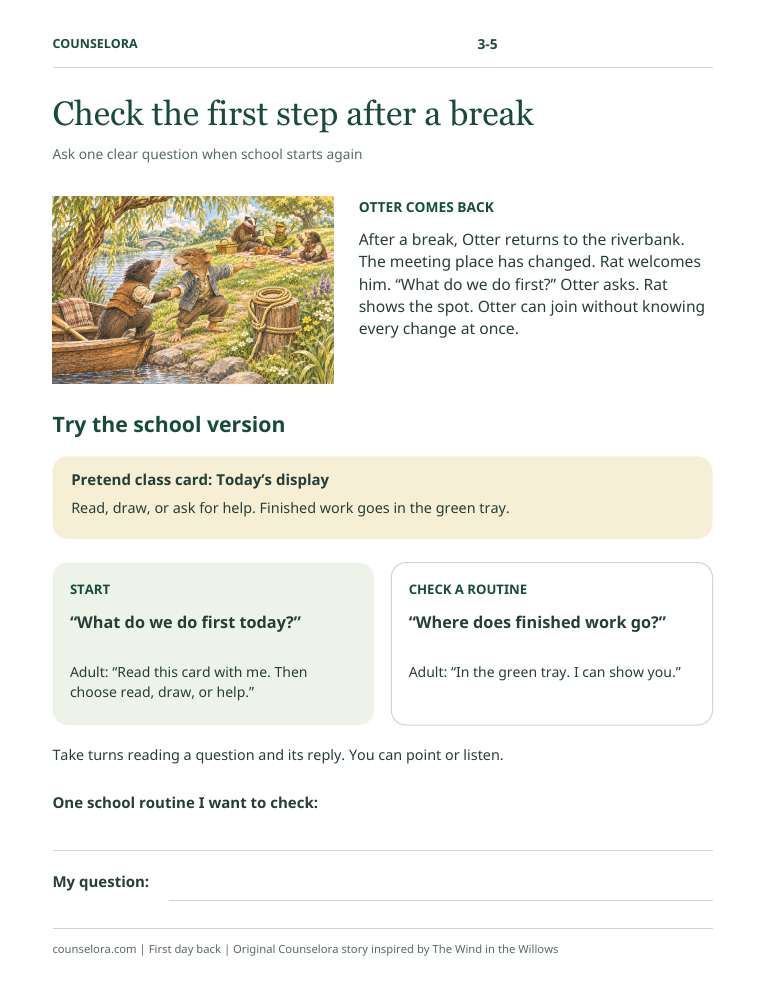
COUNSELORA 3-5 Check the first step after a break Ask one clear question when school starts again OTTER COMES BACK After a break, Otter returns to the riverbank. The meeting place has changed. Rat welcomes him. “What do we do first?” Otter asks. Rat shows the spot. Otter can join without knowing every change at once. Try the school version Pretend class card: Today’s display Read, draw, or ask for help. Finished work goes in the green tray. START “What do we do first today?” Adult: “Read this card with me. Then choose read, draw, or help.” CHECK A ROUTINE “Where does finished work go?” Adult: “In the green tray. I can show you.” Take turns reading a question and its reply. You can point or listen. One school routine I want to check: My question: counselora.com | First day back | Original Counselora story inspired by The Wind in the Willows
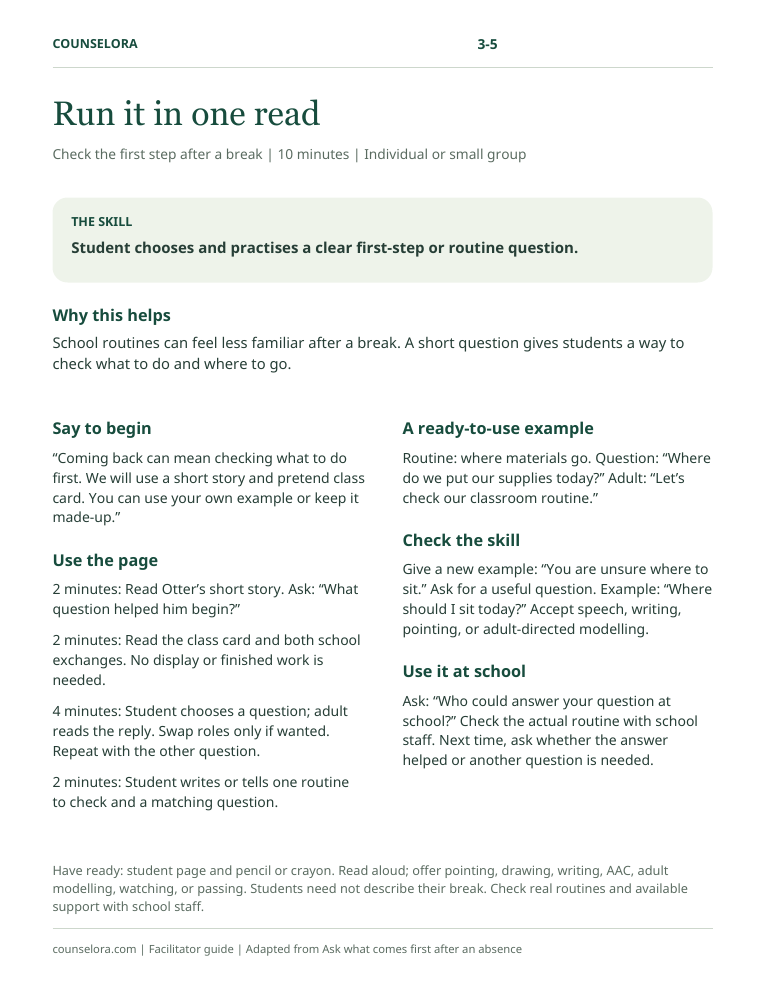
COUNSELORA 3-5 Run it in one read Check the first step after a break | 10 minutes | Individual or small group THE SKILL Student chooses and practises a clear first-step or routine question. Why this helps School routines can feel less familiar after a break. A short question gives students a way to check what to do and where to go. Say to begin “Coming back can mean checking what to do first. We will use a short story and pretend class card. You can use your own example or keep it made-up.” Use the page 2 minutes: Read Otter’s short story. Ask: “What question helped him begin?” 2 minutes: Read the class card and both school exchanges. No display or finished work is needed. 4 minutes: Student chooses a question; adult reads the reply. Swap roles only if wanted. Repeat with the other question. 2 minutes: Student writes or tells one routine to check and a matching question. A ready-to-use example Routine: where materials go. Question: “Where do we put our supplies today?” Adult: “Let’s check our classroom routine.” Check the skill Give a new example: “You are unsure where to sit.” Ask for a useful question. Example: “Where should I sit today?” Accept speech, writing, pointing, or adult-directed modelling. Use it at school Ask: “Who could answer your question at school?” Check the actual routine with school staff. Next time, ask whether the answer helped or another question is needed. Have ready: student page and pencil or crayon. Read aloud; offer pointing, drawing, writing, AAC, adult modelling, watching, or passing. Students need not describe their break. Check real routines and available support with school staff. counselora.com | Facilitator guide | Adapted from Ask what comes first after an absence
Grades 6–8
Choose a first step after a break
A short Mowgli story and practice asking a useful question. Includes a student page and counselor guide for returning after a shared school break.
Read the text version
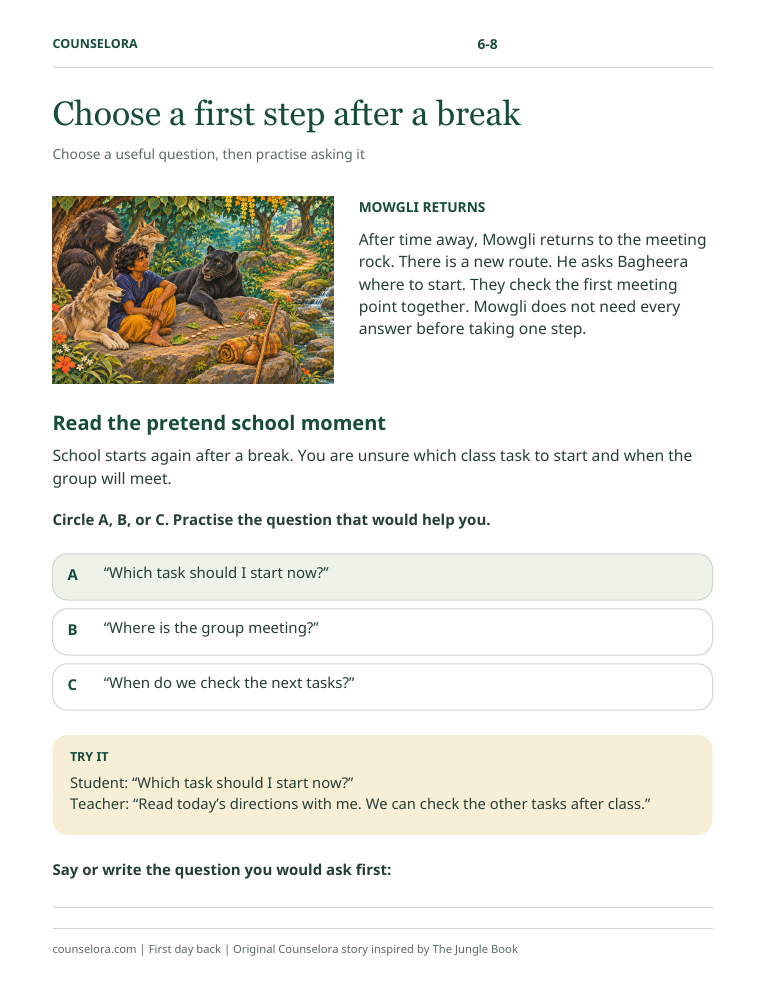
COUNSELORA 6-8 Choose a first step after a break Choose a useful question, then practise asking it MOWGLI RETURNS After time away, Mowgli returns to the meeting rock. There is a new route. He asks Bagheera where to start. They check the first meeting point together. Mowgli does not need every answer before taking one step. Read the pretend school moment School starts again after a break. You are unsure which class task to start and when the group will meet. Circle A, B, or C. Practise the question that would help you. A “Which task should I start now?” B “Where is the group meeting?” C “When do we check the next tasks?” TRY IT Student: “Which task should I start now?” Teacher: “Read today’s directions with me. We can check the other tasks after class.” Say or write the question you would ask first: counselora.com | First day back | Original Counselora story inspired by The Jungle Book
COUNSELORA 6-8 Run it in one read Choose a first step after a break | 10 minutes | Individual or small group THE SKILL Student chooses a useful question for the first day back and practises asking it. Why this helps Returning after a break can mean switching back to school schedules and expectations. Practising one clear question gives students a way to find a starting point and ask for support. Say to begin “School is starting again. Practise asking for a starting point with this pretend situation. You do not need to share anything about your break.” Use the page 2 minutes: Read the story and school moment. The class task and meeting are fictional. 3 minutes: Student chooses A, B, or C. Ask: “How could that question help?” 3 minutes: Practise the chosen question and supplied reply. Student may say, write, or direct you to read it. 2 minutes: Student chooses a question to take into the first week back. A ready-to-use example Any question can be useful. A: “Read today’s directions with me.” B: “The group meets in Room 4.” C: “We can check after class.” All replies are for the pretend example. Check the skill Look for a clear question and a reason it helps. Ask: “If the teacher cannot talk after class, what could you ask?” Example: “When could we check, or who else can help?” Use it at school Choose a question for the first week back. Staff confirm real directions and meeting times. The example does not promise a real appointment. Have ready: student page and pencil or crayon. Read aloud; offer pointing, drawing, writing, AAC, adult modelling, watching, or passing. Students need not describe their break. Check real routines and available support with school staff. counselora.com | Facilitator guide | Adapted from Ask for a first-day-back plan
Grades 9–12
Make a first-day-back plan
Compare two practice deadlines and choose a manageable first action. Includes a student page and counselor guide for returning after a shared school break.
Read the text version
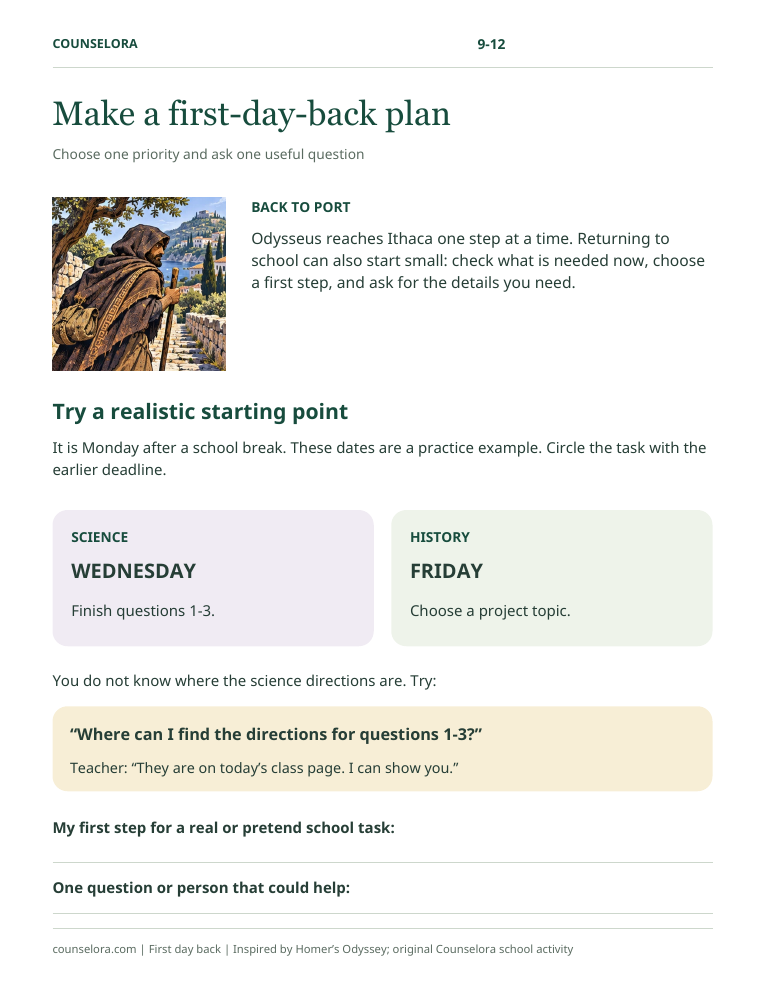
COUNSELORA 9-12 Make a first-day-back plan Choose one priority and ask one useful question BACK TO PORT Odysseus reaches Ithaca one step at a time. Returning to school can also start small: check what is needed now, choose a first step, and ask for the details you need. Try a realistic starting point It is Monday after a school break. These dates are a practice example. Circle the task with the earlier deadline. SCIENCE WEDNESDAY Finish questions 1-3. HISTORY FRIDAY Choose a project topic. You do not know where the science directions are. Try: “Where can I find the directions for questions 1-3?” Teacher: “They are on today’s class page. I can show you.” My first step for a real or pretend school task: One question or person that could help: counselora.com | First day back | Inspired by Homer’s Odyssey; original Counselora school activity
COUNSELORA 9-12 Run it in one read Make a first-day-back plan | 10 minutes | Individual or small group THE SKILL Student identifies a supplied priority and chooses a small starting action plus a useful question. Why this helps After a break, some students need time to settle into school routines and organize upcoming tasks. This activity makes room to check priorities and ask for the information needed to begin. Say to begin “You do not have to plan the whole term today. We will practise with two fictional tasks, then choose one manageable next step. You can keep your answer made-up.” Use the page 1 minute: Read Back to Port. This is a shared school break, not missed lessons. 3 minutes: Compare the dates. Science is due earlier in this example. 3 minutes: Practise the request and reply. No real schoolwork is needed. 3 minutes: Student chooses a first action and a useful question or person. A ready-to-use example First action: open today’s class page. Question: “Can you show me which directions to use?” If the page is unavailable: “Is there another way I can get the directions?” Check the skill Ask: “Why did you choose that first step?” Look for a specific action that helps the student begin. Earlier due date is one cue; real task size, access needs, and teacher guidance also matter. Use it at school Choose when to try the first action. Confirm real deadlines and supports with staff. Next check-in: “Did that help you start, or do you need a different step?” Have ready: student page and pencil or crayon. Read aloud; offer pointing, drawing, writing, AAC, adult modelling, watching, or passing. Students need not describe their break. Check real routines and available support with school staff. counselora.com | Facilitator guide | Adapted from Return after missing school