
Career comparison activity · Grades 9–12 · 20 minutes
Compare options after high school
Compare options against a priority and verify a decision-relevant fact.
Download this activity with Plus
Read the text version
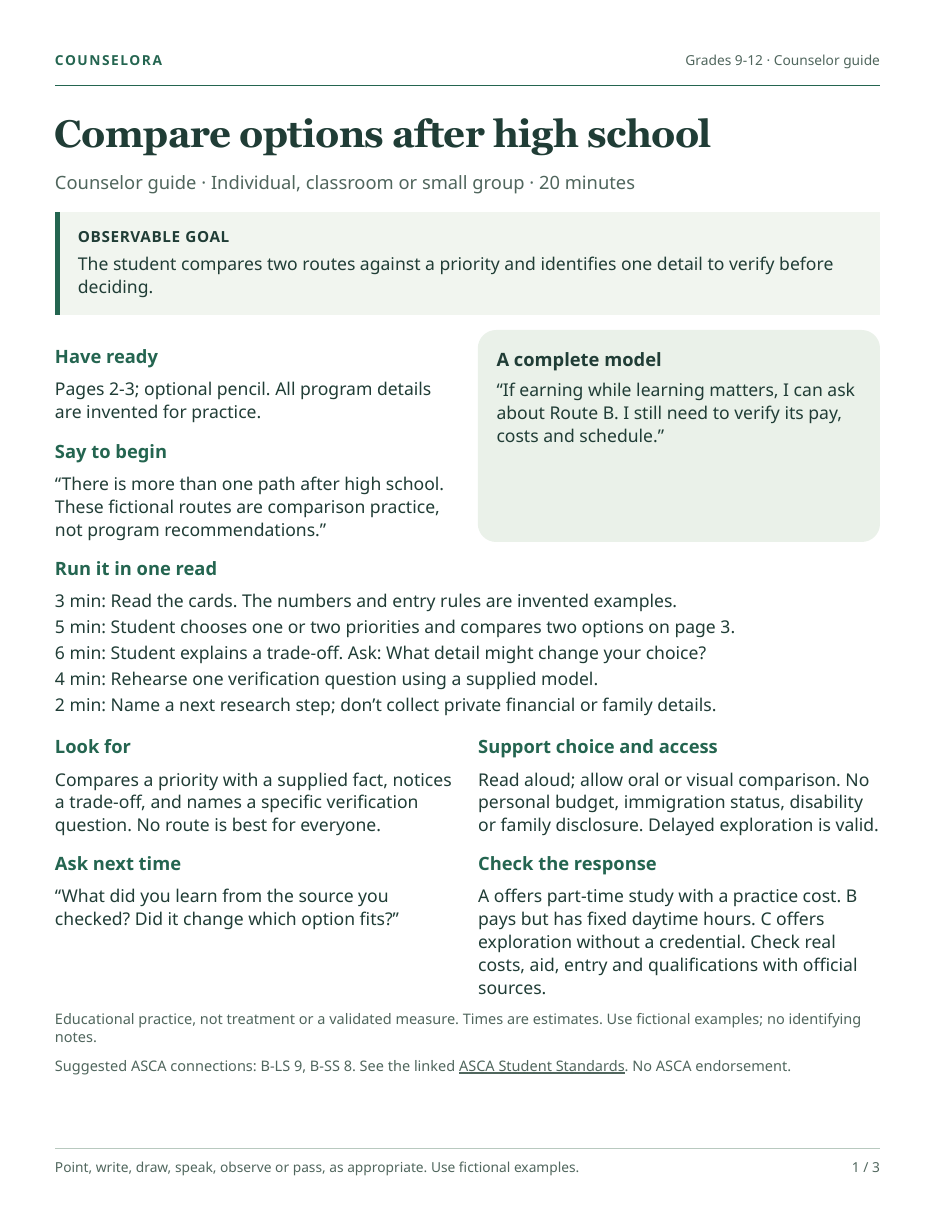
COUNSELORA Grades 9-12 · Counselor guide Compare options after high school
Counselor guide · Individual, classroom or small group · 20 minutes
OBSERVABLE GOAL The student compares two routes against a priority and identifies one detail to verify before deciding. Have ready
Pages 2-3; optional pencil. All program details are invented for practice.
Say to begin
“There is more than one path after high school. These fictional routes are comparison practice, not program recommendations.”
A complete model
“If earning while learning matters, I can ask about Route B. I still need to verify its pay, costs and schedule.”
Run it in one read 3 min: Read the cards. The numbers and entry rules are invented examples. 5 min: Student chooses one or two priorities and compares two options on page 3. 6 min: Student explains a trade-off. Ask: What detail might change your choice? 4 min: Rehearse one verification question using a supplied model. 2 min: Name a next research step; don’t collect private financial or family details. Look for
Compares a priority with a supplied fact, notices a trade-off, and names a specific verification question. No route is best for everyone.
Ask next time
“What did you learn from the source you checked? Did it change which option fits?”
Support choice and access
Read aloud; allow oral or visual comparison. No personal budget, immigration status, disability or family disclosure. Delayed exploration is valid.
Check the response
A offers part-time study with a practice cost. B pays but has fixed daytime hours. C offers exploration without a credential. Check real costs, aid, entry and qualifications with official sources.
Educational practice, not treatment or a validated measure. Times are estimates. Use fictional examples; no identifying notes.
Suggested ASCA connections: B-LS 9, B-SS 8. See the linked ASCA Student Standards. No ASCA endorsement.
Point, write, draw, speak, observe or pass, as appropriate. Use fictional examples. 1 / 3 COUNSELORA Grades 9-12 · Fictional option cards Compare options after high school
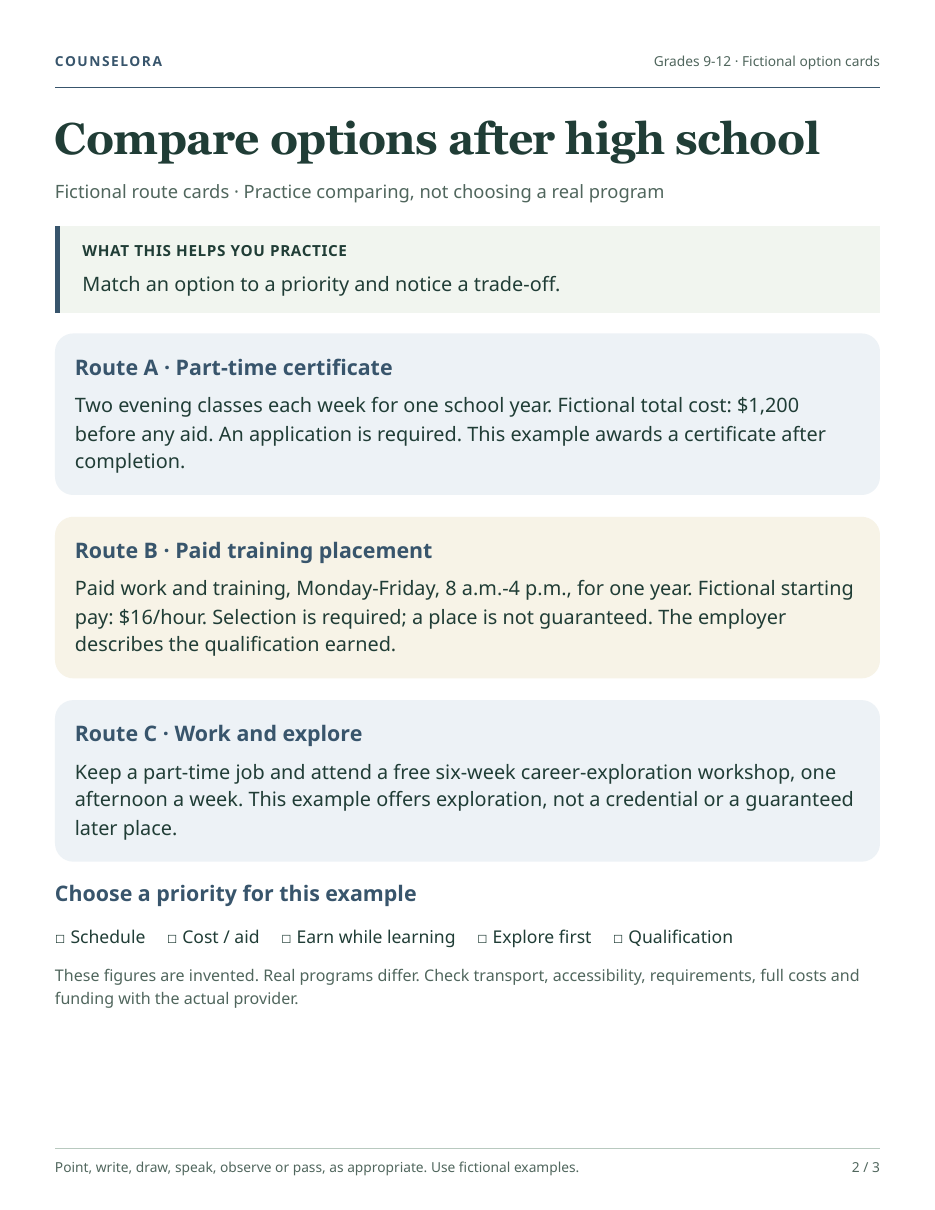
Fictional route cards · Practice comparing, not choosing a real program
WHAT THIS HELPS YOU PRACTICE Match an option to a priority and notice a trade-off. Route A · Part-time certificate
Two evening classes each week for one school year. Fictional total cost: $1,200 before any aid. An application is required. This example awards a certificate after completion.
Route B · Paid training placement
Paid work and training, Monday-Friday, 8 a.m.-4 p.m., for one year. Fictional starting pay: $16/hour. Selection is required; a place is not guaranteed. The employer describes the qualification earned.
Route C · Work and explore
Keep a part-time job and attend a free six-week career-exploration workshop, one afternoon a week. This example offers exploration, not a credential or a guaranteed later place.
Choose a priority for this example Schedule Cost / aid Earn while learning Explore first Qualification
These figures are invented. Real programs differ. Check transport, accessibility, requirements, full costs and funding with the actual provider.
Point, write, draw, speak, observe or pass, as appropriate. Use fictional examples. 2 / 3 COUNSELORA Grades 9-12 · Compare and verify Compare options after high school
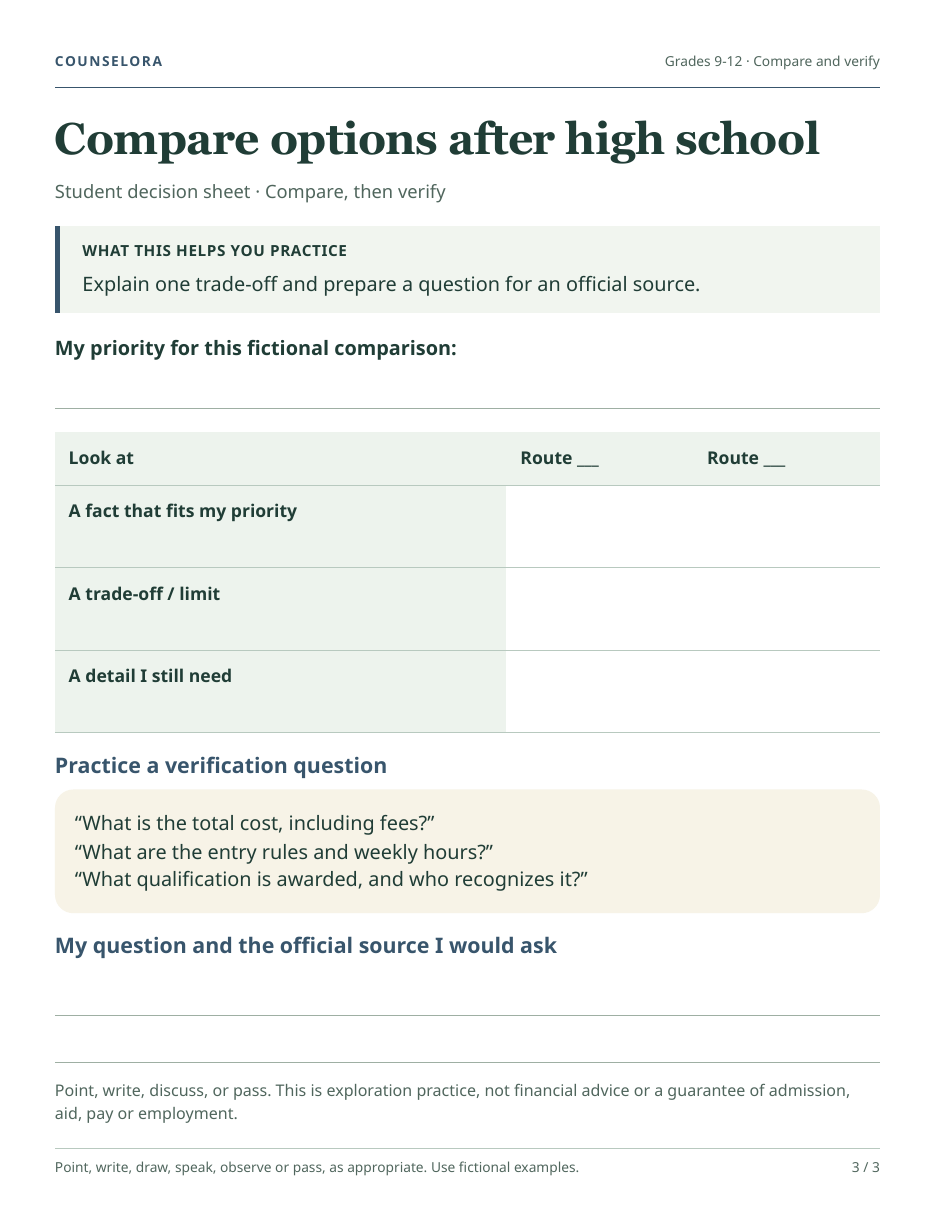
Student decision sheet · Compare, then verify
WHAT THIS HELPS YOU PRACTICE Explain one trade-off and prepare a question for an official source.
My priority for this fictional comparison:
Look at Route ___ Route ___ A fact that fits my priority A trade-off / limit A detail I still need Practice a verification question
“What is the total cost, including fees?” “What are the entry rules and weekly hours?” “What qualification is awarded, and who recognizes it?”
My question and the official source I would ask
Point, write, discuss, or pass. This is exploration practice, not financial advice or a guarantee of admission, aid, pay or employment.
Point, write, draw, speak, observe or pass, as appropriate. Use fictional examples. 3 / 3
Visual descriptions: